Food Connects – The Food Sharing App
ABOUT THE PROJECT
This project showcases an innovative approach to tackling the issue of food waste in private households. Leveraging the power of design thinking, our team of three students has crafted a user-friendly app designed to facilitate the sharing of surplus food within local communities. Users can list or claim food items and coordinate exchanges through in-app messaging. The app not only addresses food waste but also fosters a sense of community and support.
Method // Design Thinking
Deliverables // personas, POV‘s, user flows, interactive prototype
Tasks // user research, ideating, prototyping
Tools // Figma, Indesign, Illustrator, Miro
Phase 1 – Empathize
SURVEY
For the initial user research we conducted a survey to understand the nuances of food waste at a personal level. Through this, we uncovered the common causes leading to waste, such as over-purchasing, big packaging at supermarkets, and a lack of awareness.

Phase 2 – Define
PERSONAS
POINT OF VIEWS
To visualize the insights gained in the previous phase we created two personas to represent our target group. We kept their pain points and needs in mind during the following project phases.
By asking "how might we" questions we were able to view the identified challenges from a new perspective. These questions serve as a foundation for the following ideation phase by creating a positive, solution-oriented mindset and sharpening the focus.
Phase 3 – Ideate
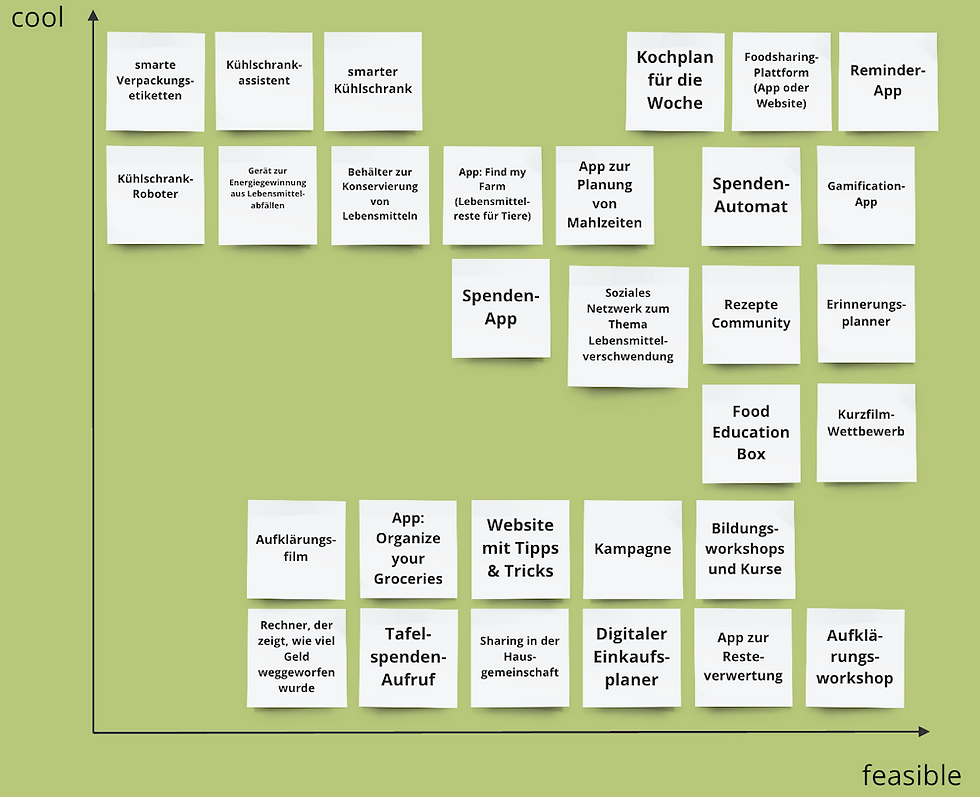
BRAINSTORMING
In the ideate phase, we brainstormed a myriad of solutions, evaluating their feasibility and impact. The concept of a neighborhood-centric app emerged as a frontrunner, promoting local exchange to ensure food reaches those who need it before it spoils.
...help the target group to use up food before it spoils?
...help the target group to avoid the problem of excessively large food packaging?
...help the target group to plan their meals in advance?
...help the target group to get a better overview of their pantry?
...help the target group to reduce food waste without investing a lot of time?
...help the target group to avoid impulse purchases?
...help the target group to extend the shelf life of food?
...help the target group to share leftover food with others?
how might we ...
BEHAVIOR
Emma prefers to buy organic and locally sourced produce. She often participates in community clean-up events and is active in online forums dedicated to sustainability. Emma uses public transportation or her bicycle for most of her commutes and is always on the lookout for eco-friendly products and services.
GOALS
-
To live a zero-waste lifestyle as much as possible.
-
To contribute to reducing food waste in her community.
-
To promote sustainable living practices among her friends and online followers.
PAIN POINTS
-
Struggles to find convenient ways to reduce food waste without compromising her busy schedule.
-
Often finds it challenging to source affordable, organic produce that aligns with her vegan diet.
-
Feels frustrated by the lack of community engagement in sustainability initiatives.

Emma
Emma is a 36-year-old marketing manager living in Hamburg. She is deeply committed to sustainability and is always looking for ways to minimize her carbon footprint. Emma is well-educated, socially active, and follows a vegan diet.
Phase 4 – Prototype
NAVIGATION STRUCTURE
Our objective was to create an intuitive framework that organizes the content of the app effectively. Through careful analysis, we crafted an architecture and layed the foundation for a user-friendly interface.
SKETCHES
Transitioning from structure to design, we turned to sketches to bring our concepts to life. These initial sketches served as a visual representations of our app’s potential layout and flow. Through a collaborative and iterative process, we visualized the core components, allowing rapid exploration of design ideas and swift modifications in response to user feedback.
HIGH FIDELITY PROTOTYPE
In the next step we chose a name, colors, icons, fonts and a logo for the app and crafted the initial version of a high fidelity prototype.
Phase 5 – Test
IMPLEMENTING USER FEEDBACK
We conducted user tests and interviews to evaluate and continually improve the prototype in three iterations. We observed user interactions, gathered feedback, and refined the interface to align closely with user needs and expectations.

Final Result
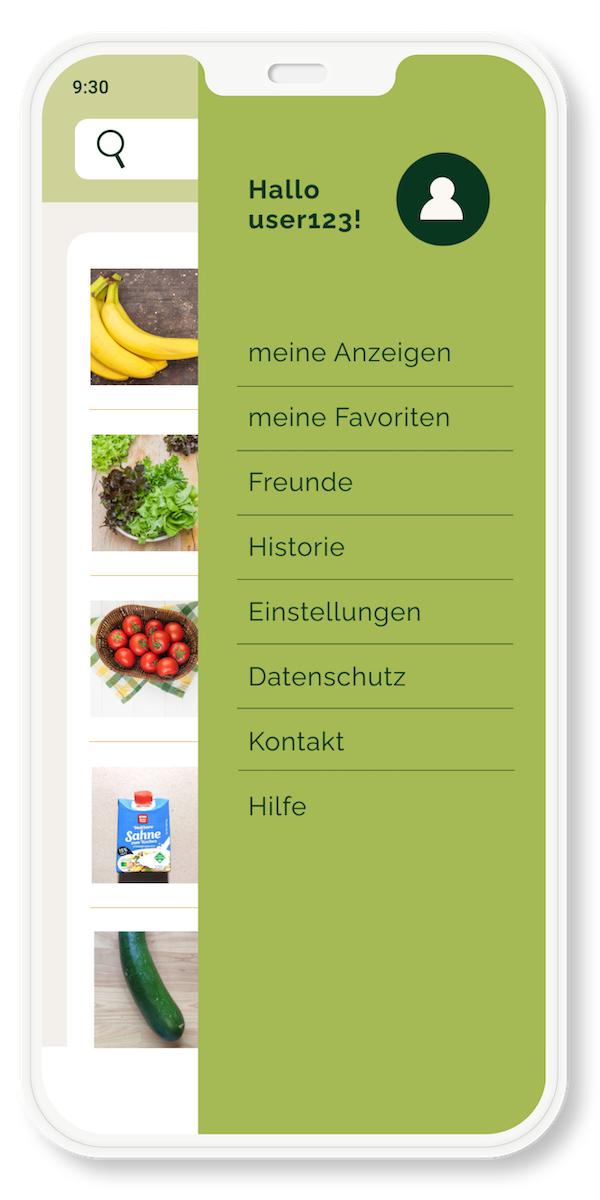
The result of our design thinking journey is our final interactive prototype. This prototype was meticulously developed to offer a seamless and intuitive user experience, mirroring the fluidity of popular online marketplaces with a specialized focus on community food sharing. With this prototype users can simulate the entire process of listing an item, searching for goods, and initiating contact with another user.




.png)


PAIN POINTS
Hannelore lives alone and struggles to use up her groceries before they go bad. She also loves gardening and usually harvests way more than she can use.
GOALS
Hannelore would like an easy solution for sharing her harvest and leftover groceries with her neighbors.
ABOUT
Hobbies: gardening, crocheting, reading
Food habits: Homecooked meals
Values: security, tradition

Hannelore (70)
retired teacher
widowed
BEHAVIOR
Ben shops for groceries with a strict budget in mind, often looking for discounts and deals. Ben uses budgeting apps to track his expenses and is always willing to share cost-saving tips with friends.
GOALS
-
To maintain a healthy and balanced diet while sticking to his budget.
-
To find creative ways to reduce his living expenses.
-
To share and gain knowledge on budget-friendly living and eating habits.
PAIN POINTS
-
Encounters difficulty in accessing affordable, fresh produce and other ingredients needed for a balanced diet.
-
Sometimes wastes food due to poor planning or impulse purchases.
-
Feels a social disconnect when unable to participate in activities or dining out due to budget constraints.

Ben
Ben is a 24-year-old graduate student studying economics. He lives in a shared apartment close to his university in Mannheim. With a tight budget, Ben is always looking for ways to cut costs without sacrificing his quality of life.